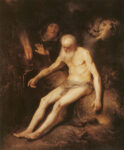
The Cross Awaits You

“THE cross, therefore, is always ready; it awaits you everywhere. No matter where you may go, you cannot escape it, for wherever you go you take yourself with you and shall always find yourself. Turn where you will — above, below, without, or within — you will find a cross in everything, and everywhere you must have patience if you would have peace within and merit an eternal crown.”

Thomas à Kempis

(more…)

0 Comments

Museum Warfare

THE docent began the tour by taking us to the second floor landing of the museum as snow fell gently on the famous lawn outside, beckoning with its placid rhythm and complete lack of artifice.

The guide stopped at a glass case. In the case was a mannequin clothed in what appeared to be old, knitted afghan doilies, the sort of things that sit around on sofas and tables for many years in humble homes — not bad in the right place, but not treasured by anyone as visual masterpieces.

The artist, we are informed, has created similar suits for museums across the country (another way of saying he is a millionaire.) He was inspired in this work by his desire to create a second skin for himself — a protective suit that would enable him to escape racism and the evils of class and gender. He wanted a suit that would entirely insulate him from these scourges and that also made interesting crinkly sounds because he was a “multimedia artist” and performer.

We stood speechless before this afghan-covered shaman. I felt reverence and awe — awe for the immense power of propaganda. I was not surprised the enthusiastic female guide chose to take us here first. I don’t know what the other participants were thinking, if they were thinking at all, but I was fantasizing about what it’s like to make lots of money collecting old, cheap doilies in thrift shops and creating suits out of them. It can’t be that hard to do and might potentially make for a very comfortable and happy life, but no one would make lots of money doing this unless he fell into a certain privileged racial category and class. Our artist had, of course, the proper biological credentials. So the suit, as it turned out, was not only not pleasing to the eye, it did not insulate anyone from the scourge of racism.

Oh, racism! How you plague the museum curator! On the one hand, she must bow to the dogmas of equality because that is her religion and the whole reason she took all those boring courses to get this job. On the other hand, she is surrounded in the museum’s vast and stunning collections with proof that equality does not exist. That’s a terrible bind, you have to admit.

To escape this dilemma, she and her volunteer guides, her fellow deacons at the altars of art, resort to piety and hoaxes.

(more…)

0 Comments

Femininity Inspires Masculinity

                                                        Azalea, Carl Larsson; 1906

MEN are, in general, motivated to take on the hard work of supporting families by feminine women. It is worth repeating this fact again and again because so many are taught that men and women are essentially the same. Given this fact, the more power women accumulate in society and the more career success they achieve, the less happiness both men and women find in marriage and the more demographic decline a society sees. Civilization and the feminist imperative are wholly incompatible.

This comment by a reader from 2014 never grows stale:

Men are naturally barbaric; left to their own devices, many males are perfectly happy to live in relative squalor. (Those disinclined to believe this are urged to hang out with a young single guy sometime). What prevents this from happening? In the traditional societies of the past, both the father and the mother (as well as other relatives and respected figures in the community) had important roles to play in civilizing boys and turning them into men.

It was the job of a father, an older brother, or perhaps a priest, drill instructor or coach to teach the boy what behavior and conduct was expected of him as a man. The mother’s role was just as vital, but different. Her job was to educate and civilize her son – not only by teaching him how a gentleman conducts himself around a lady, but by providing a comforting home and exposure to the things such as culture, manners, and all of the other habits great and small that comprise civilized behavior. Grace, beauty, decorum, kindness and all of the things that comfort us – these are the things that turn a house into a home, and into a refuge from a sometimes cold world outside that front door. Only a mother or a wife can provide those things. (more…)

0 Comments

The Intimate Friendship of Jesus

“WHEN Jesus is near, all is well and nothing seems difficult. When He is absent, all is hard. When Jesus does not speak within, all other comfort is empty, but if He says only a word, it brings great consolation. Did not Mary Magdalen rise at once from her weeping when Martha said to her: ‘The Master is come, and calleth for thee’? Happy is the hour when Jesus calls one from tears to joy of spirit. How dry and hard you are without Jesus! How foolish and vain if you desire anything but Him! Is it not a greater loss than losing the whole world? For what, without Jesus, can the world give you? Life without Him is a relentless hell, but living with Him is a sweet paradise. If Jesus be with you, no enemy can harm you.”

— Thomas á Kempis, The Imitation of Christ

(more…)

0 Comments

Are Jews the Chosen People?

DREW TREGLIA investigates this question by engaging in conversation with Jews at a festival in Arizona.

(more…)

0 Comments

Epstein Worked with Russians to Bring Down West

“THEY’ve tracked Epstein’s activities and operations back to the 1970s.

Former head of MI6’s Russia desk, Christopher Steele, says it appears to him that, as early as the 1970s, Epstein was “effectively involved in Russian organised crime.” (more…)

0 Comments

Marriage and Political Freedom

“THE citizen by himself is no match for the city. There must be balanced against it another ideal institution, and in that sense an immortal institution. So long as the state is the only ideal institution the state will call on the citizen to sacrifice himself, and therefore will not have the smallest scruple in sacrificing the citizen. The state consists of coercion; and must always be justified from its own point of view in extending the bounds of coercion; as, for instance, in the case of conscription. The only thing that can be set up to check or challenge this authority is a voluntary law and a voluntary loyalty. That loyalty is the protection of liberty, in the only sphere where liberty can fully dwell. It is a principle of the constitution that the King never dies. It is the whole principle of the family that the citizen never dies. There must be a heraldry and heredity of freedom; a tradition of resistance to tyranny. A man must be not only free, but free-born.”

— G.K. Chesterton, The Superstition of Divorce1920

(more…)

0 Comments

A Bit of Erma

Erma_Bombeck_House

THE housewife-humorist Erma Bombeck raised three children and churned out newspaper columns from this suburban house in Centerville, Ohio, a house which was considered modest then but is probably out of reach for most young couples today. Bombeck wrote the column below, “Are We Rich?,” for publication on June 3, 1971. She eventually did become rich from the hundreds of humorous pieces she wrote about her domestic world. She neither romanticized nor disparaged her way of life. It was a world where men were still men and women were still women. Having started them in 1964, her columns were syndicated to 900 newspapers by 1978. Though she unfortunately would later go on to campaign for the Equal Rights Amendment, she was not initially enthusiastic about the feminist movement, once saying of Betty Friedan and her fans, “These women threw a war for themselves and didn’t invite any of us.”

“Are We Rich?” by Erma Bombeck

The other day out of a clear blue sky Brucie asked, “Are we rich?”

I paused on my knees as I retrieved a dime from the sweeper bag, blew the dust off it and asked, “Not so you can notice. Why?”

“How can you tell?” he asked.

I straightened up and thought a bit. Being rich is a relative sort of thing. Here’s how I can always tell. (more…)

0 Comments

Singing on a Bus


[Reposted from Sept. 30, 2016]

ALAN writes:

I recently came across a passage in a 2003 essay by Gary North about how it was once common in America for strangers traveling on Greyhound buses to sing during the ride. [“The Way We Were”, Aug. 18, 2016]

North wrote:

There is a scene in “It Happened One Night” (1934), where Clark Gable is riding in a bus. The bus is lighted inside, and everyone is singing.   For years, I thought that scene was filler. My friend and master journalist Otto Scott, age 85, tells me that singing on Greyhound buses was common in those days, though with lights off.  Strangers sang on buses. I cannot identify with such a world.

Try a little harder, Gary. Singing on the bus is the kind of thing you get when people have heritage, culture, and values in common.  It is not the kind of thing you get in a “multi-culture.” (more…)

0 Comments

Only Spinsters Have It all

“PURSUIT of achievement in literature, science and the arts is a single-minded ambition that will never be restructured … men are right when they say that the required expenditure of time and effort leaves little room for life’s other rewards.”

— Feminist author Susan Brownmiller, Femininity (Ballantine Books, 1985)

(more…)

0 Comments

Happy Candlemas

Master of Bagnacavallo Italian; ca. 1278


CANDLEMAS HYMN

The angel-lights of Christmas morn,
Which shot across the sky,
Away they pass at Candlemas,
They sparkle and they die.

Comfort of earth is brief at best,
Although it be divine;
Like funeral lights for Christmas gone,
Old Simeon’ s tapers shine.

And then for eight long weeks and more,
We wait in twilight grey,
Till the High Candle sheds a beam
On Holy Saturday.

We wait along the penance-tide
Of solemn fast and prayer,
Whilst song is hushed, and lights grow dim,
In the sin-laden air. (more…)

0 Comments

The Feast of Mary’s Purification

SHE was in the Temple of Jerusalem what she was in the house of Nazareth, when she received the Archangel’s visit — she was the Handmaid of the Lord. (Luke 1:38) She obeyed the Law, because she seemed to come under the Law. Her God and her Son submitted to the ransom as humbly as the poorest Hebrew would have to do; he had already obeyed the edict of the emperor Augustus, in the general census; he was to be obedient even unto death, even to the death of the Cross. The Mother and the Child, both humbled themselves in the Purification, and man’s pride received, on that day, one of the greatest lessons ever given it.”

— Dom Prosper Guéranger, “The Feast of the Purification of the Blessed Virgin”

(more…)

0 Comments

Down with the Holly and the Box

CEREMONIES FOR CANDLEMAS EVE
by Robert Herrick

DOWN with the rosemary and bays,
Down with the misletoe ;
Instead of holly, now up-raise
The greener box (for show).

The holly hitherto did sway ;
Let box now domineer
Until the dancing Easter day,
Or Easter’s eve appear.

Then youthful box which now hath grace
Your houses to renew ;
Grown old, surrender must his place
Unto the crisped yew. (more…)

0 Comments

Candlemas Is Come At Last

NOW Candlemas is come at last, therefore my dearest friend,
Since Christmas time is almost past, I mean to make an end
Of this our mirth and merriment, and now the truth to tell,
He must be from our presence sent, O Christmas, now farewell.
Now Christmas will no longer stay, my very heart doth grieve,
Before from us he take his way, of him I’ll take my leave: (more…)

0 Comments

Nation and Soul

“THE man without a country is like the man suspended in mid-air because he lacks the concrete things that a nation offers — a village, a language, a way of life and a means of providing it — in order to accomplish even his most basic tasks. Are there problems inherent in the individual-nation relationship? Many, because one may be tempted to break the moral code for the benefit of his country just as one can be led astray in his family’s self-interest. Do the difficulties that it engenders justify its abandonment? No more than a father’s crimes on behalf of his children legitimate rejection of the family structure.”

Dr. John C. Rao, “Americanism and the Collapse of the Church in the United States”

(more…)

0 Comments

The Light in the Window

ALAN writes:

One night last year, in the darkness just before I fell asleep, my eye was attracted by a light in an upstairs window of a neighboring house. It prompted me instantly to recall nights in the Autumn of 1965 when I glanced out my bedroom window just before going to sleep and saw a light in an upstairs window of the house next door. And that memory brought a trainload of others with it.

In late summer that year, we moved to a new residence in south St. Louis in the “Mount Pleasant” neighborhood, where daily life was indeed pleasant. I was fifteen and going to classes in a Catholic high school. To me at that age, life was still inviting and enchanting. The whole universe lay before me, or so it seemed.  In one corner of my bedroom, I kept a small collection of books and magazines about astronomy, a prism, binoculars, and a telescope. On a wall, I placed maps of the night sky and the moon. I was blissfully ignorant of cultural trends and wholly unaware that a cultural revolution was taking place in America.

(more…)

0 Comments

Dogma Unites, Relativism Divides

                                           Fern Coppedge, Michener Art Museum

FROM What’s Wrong with the World by G.K. Chesterton:

Some people do not like the word “dogma.” Fortunately they are free, and there is an alternative for them. There are two things, and two things only, for the human mind, a dogma and a prejudice. The Middle Ages were a rational epoch, an age of doctrine. Our age is, at its best, a poetical epoch, an age of prejudice. A doctrine is a definite point; a prejudice is a direction. That an ox may be eaten, while a man should not be eaten, is a doctrine. That as little as possible of anything should be eaten is a prejudice; which is also sometimes called an ideal. Now a direction is always far more fantastic than a plan. I would rather have the most archaic map of the road to Brighton than a general recommendation to turn to the left. Straight lines that are not parallel must meet at last; but curves may recoil forever. A pair of lovers might walk along the frontier of France and Germany, one on the one side and one on the other, so long as they were not vaguely told to keep away from each other. And this is a strictly true parable of the effect of our modern vagueness in losing and separating men as in a mist.

(more…)

0 Comments